Streamlining Philanthropy with a Professional KDP Interior Donation Tracker
In the evolving landscape of self-publishing and low-content book creation, specificity is the primary driver of market success. While general journals and notebooks face saturation, niche functional tools like the KDP Interior Donation Tracker address distinct organizational needs for charities, religious groups, political campaigns, and individual philanthropists. This specialized format transforms a standard notebook into a compliant financial instrument, bridging the gap between analog record-keeping and professional accountability. Understanding the technical and practical dimensions of this 6″ x 9″ interior is essential for creators aiming to provide genuine utility rather than mere aesthetic appeal.
The Strategic Advantage of the 6x9 Form Factor
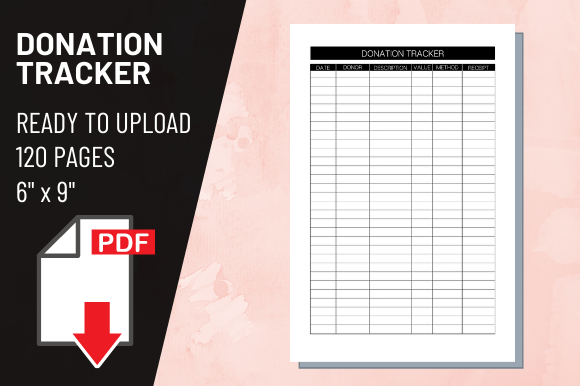
The decision to utilize a 6″ x 9″ trim size for a donation tracker KDP interior is not arbitrary; it is a deliberate ergonomic and logistical choice that dictates how the end-user interacts with the product. Unlike larger 8.5″ x 11″ ledgers that demand desk space and are cumbersome to transport, the 6x9 format offers portability without sacrificing writing surface area. For field organizers, event coordinators, or treasurers attending off-site fundraisers, this size fits comfortably in a bag or large coat pocket, allowing for real-time data entry at the point of transaction.
From a production standpoint, the 6x9 dimension optimizes spine width relative to page count. With 120 pages, the resulting book has enough physical presence to feel substantial and durable, yet remains lightweight. This balance is critical for user adoption. A donation log must be perceived as a permanent archive; if it feels flimsy, users may hesitate to trust it with sensitive financial data. Conversely, if it is too heavy, it becomes a burden. The 120-page count specifically allows for tracking approximately 100 to 110 unique transactions when accounting for title pages and notes sections, which aligns perfectly with quarterly reporting cycles or specific fundraising campaign durations.
Technical Precision: Resolution and Bleed Specifications
For publishers and designers, the integrity of the final printed product hinges on adherence to strict manufacturing specifications. The package inclusion of a 300 dpi PDF file is non-negotiable for text-heavy functional books. While some image-based interiors can tolerate lower resolutions, a donation tracker relies on crisp lines, legible typography, and high-contrast tables. At 300 dpi, the grid lines remain sharp rather than pixelated, reducing eye strain during data entry and ensuring that photocopies or scans of the pages remain readable for auditing purposes.
The "no bleed" specification fundamentally alters the design architecture of the KDP Interior Donation Tracker. Without bleed, all content must reside within a defined safe zone, typically maintaining a margin of at least 0.375 inches from the trim edge on the outside and significantly more on the gutter (binding) side. This constraint requires a sophisticated understanding of layout balance. Tables cannot extend to the page edge; instead, they must be centered or aligned with ample white space to prevent text from being swallowed by the binding curve. This limitation actually enhances usability, as it forces a cleaner, less cluttered design that provides necessary breathing room for handwritten entries. Users need space to write comfortably without their pens slipping off the page or their handwriting becoming illegible near the spine.
Functional Anatomy of an Effective Tracking System
A high-quality donation tracker KDP interior distinguishes itself through thoughtful column architecture. Generic lined paper fails to capture the nuance required for financial compliance. An effective template integrates specific fields that anticipate the user's workflow. Beyond simple date and amount columns, superior interiors include dedicated spaces for donor contact information, payment method categorization (cash, check, digital transfer), and tax-deductible status indicators.
This structured approach serves multiple stakeholders. For the recorder, it acts as a cognitive checklist, ensuring no vital detail is omitted during busy intake periods. For the accountant or auditor reviewing the records later, standardized columns allow for rapid scanning and data extraction. Furthermore, including a running total column or periodic summary pages within the 120-page structure adds significant value. These features transform the book from a passive receptacle of numbers into an active management tool that helps organizations monitor progress toward fundraising goals in real time.
Compliance and Record Retention Considerations
The physical nature of this tracker addresses a critical aspect of nonprofit management: audit trails. Digital systems are excellent but vulnerable to corruption, hacking, or platform obsolescence. A printed KDP Interior Donation Tracker provides an immutable, offline backup that satisfies many regulatory requirements for primary source documentation. When creating or selecting these interiors, one must consider the legal lifespan of financial records. The 120-page volume supports archival storage, allowing organizations to shelve completed logs as part of their permanent compliance history.
Additionally, the privacy aspect of a physical book cannot be overstated. In an era of increasing data breaches, keeping donor information in a locked, physical ledger mitigates cybersecurity risks. However, this places a premium on the quality of the interior design. If the paper opacity is poor or the ink bleeds through, confidentiality is compromised. While KDP standard paper has limitations, designing with adequate spacing and avoiding double-sided printing of sensitive tables (or using single-sided layouts within the 120-page count) can mitigate show-through issues, preserving the integrity and privacy of the recorded data.
Diverse Applications Across User Segments
The versatility of the donation tracker KDP interior extends far beyond traditional charitable organizations. Educational institutions frequently utilize these trackers for classroom fundraisers, scholarship funds, or alumni giving campaigns. Teachers and PTA members benefit from the simplified, pre-formatted structure which reduces administrative overhead and ensures consistency even when volunteer leadership rotates annually. The 6x9 size is particularly advantageous in school settings where storage space is limited and portability between classrooms or events is necessary.
Political campaigns and advocacy groups represent another vital demographic. During canvassing or phone banking operations, volunteers often collect small-dollar donations or pledges. A portable, standardized tracker ensures that field data matches headquarters' expectations, streamlining the reconciliation process. Similarly, religious organizations use these interiors for tithing, building funds, or benevolence ministries. In these contexts, the discretion afforded by a nondescript 6x9 book is often preferred over digital devices that might display notifications or appear distracting during sensitive interactions.
Customization and Value Addition Strategies
While the base KDP Interior Donation Tracker provides the structural foundation, successful implementation often involves contextual adaptation. Creators should consider how the 120-page limit influences content density. Including instructional pages at the front regarding best practices for receipt issuance or tax acknowledgment letters elevates the product from a simple logbook to an educational resource. This added layer of expertise demonstrates E-E-A-T (Experience, Expertise, Authoritativeness, and Trustworthiness) and justifies a higher price point.
Furthermore, the no-bleed requirement encourages creative use of headers and footers within the safe zone. Adding subtle branding elements, inspirational quotes relevant to philanthropy, or reference tables (such as current mileage rates or standard deduction amounts) utilizes negative space effectively. These micro-features enhance the user experience without violating printing constraints. The goal is to create a resource that users reach for instinctively because it solves adjacent problems, not just the primary task of recording numbers.
Optimizing Workflow Integration
The true test of any donation tracker KDP interior is how seamlessly it integrates into existing workflows. It should not exist in isolation but rather serve as the intake mechanism that feeds broader accounting systems. Designers and users alike must view the 6x9 format as a component of a hybrid ecosystem. The layout should facilitate easy transcription into spreadsheets or database software. Consistent column widths, clear headings, and logical grouping of related data points reduce transcription errors and speed up end-of-month reconciliation.
For business owners and professionals selling these interiors, understanding this workflow integration is key to marketing. Highlighting features like "spreadsheet-compatible columns" or "audit-ready formatting" speaks directly to the pain points of treasurers and administrators. The 300 dpi resolution ensures that even if a user scans a page to email to an accountant, the digital replica retains perfect clarity. This interoperability between physical and digital realms is what makes the modern KDP interior relevant in a tech-first world.
Ultimately, the effectiveness of a KDP Interior Donation Tracker lies in its ability to impose order on chaos. Fundraising is inherently dynamic and often disorganized; the tracker provides the static framework necessary for accountability. By adhering to precise technical standards—6x9 dimensions, 120 pages, 300 dpi, no bleed—and focusing on user-centric design principles, creators deliver a tool that respects both the donor's generosity and the organization's fiduciary responsibility. This alignment of form, function, and compliance defines the gold standard for low-content publishing in the nonprofit sector.