Evaluating the KDP Habit Tracker Interior for Self-Publishing
For self-publishers and digital product creators, sourcing high-quality interiors is often the bottleneck in scaling a low-content book business. The KDP Habit Tracker Interior addresses this specific friction point by providing a pre-formatted, editable foundation rather than a static template. This resource is designed for professionals, educators, and entrepreneurs who need to launch functional journals without spending dozens of hours on layout design. The package includes an 8.5 x 11-inch interior spanning 100 pages, delivered with both Adobe InDesign and PowerPoint source files alongside a print-ready PDF. This combination of formats suggests a focus on workflow flexibility, allowing users to either customize the asset extensively or upload it immediately.
Structural Components and Layout Utility
The effectiveness of any habit tracker relies entirely on its usability. If the end-user finds the layout confusing or restrictive, the book fails its primary purpose. This KDP Habit Tracker Interior structures the 100 pages into three distinct functional areas that cover the essential tracking needs of most adults.
Ownership and Personalization Page
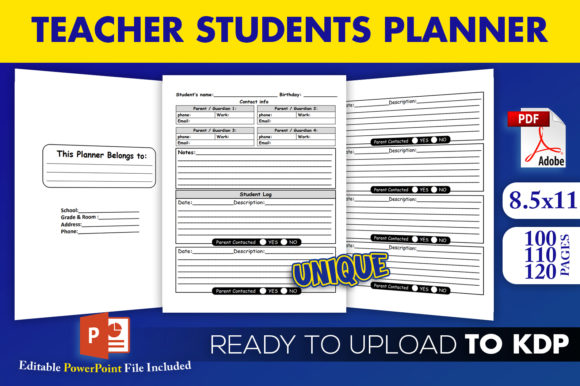
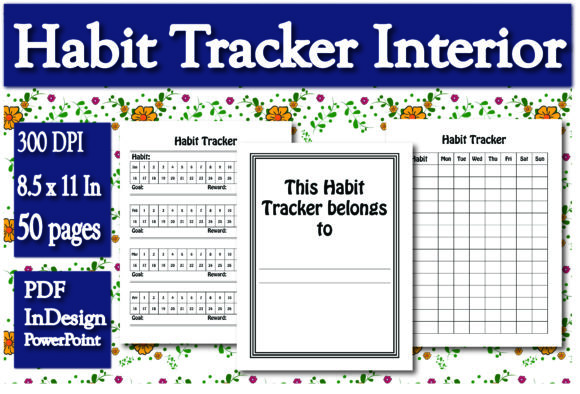
The inclusion of a “This Habit Tracker belongs to” page serves two practical functions. First, it establishes immediate user ownership, which psychological studies on journaling suggest increases adherence to the tracking routine. Second, from a publishing standpoint, it acts as a necessary front-matter buffer. It separates the title page from the functional content, ensuring that when Amazon’s preview algorithm generates the "Look Inside" feature, the customer sees a professional opening rather than jumping abruptly into grid lines. For publishers creating branded journals for corporate wellness programs or coaching clients, this page also offers a designated space for custom logos or dedications without disrupting the main layout.
Monthly Tracker Architecture
The monthly tracker section provides the macro-view necessary for long-term goal setting. In this 8.5 x 11 format, the monthly spreads typically allow for tracking up to 31 days across multiple habits. The value here lies in the balance between density and whitespace. A common failure in amateur habit tracker designs is cramming too much data into a single spread, resulting in writing spaces that are too small for comfortable use. This interior appears calibrated for standard pen widths and handwriting sizes, ensuring that users can actually write legibly within the designated boxes. For marketers and creators repurposing this interior, the monthly section is the primary selling point shown in listing images, as it demonstrates the book's capacity for comprehensive oversight.
Weekly Tracker Granularity
While monthly trackers provide overview, weekly trackers drive daily execution. The weekly sections in this KDP Habit Tracker Interior break down goals into manageable seven-day sprints. This granularity is where the actual behavioral change occurs for the end-user. From a production perspective, the weekly layout must maintain consistent margins and gutter safety zones throughout the repetition. Because this file is provided in InDesign, the master page functionality ensures that these repetitive elements remain perfectly aligned. If a user needs to adjust the line weight or font size for accessibility compliance, they can update the master page once and have it propagate across all weekly spreads instantly, eliminating the risk of formatting drift that often plagues manually assembled PDFs.
Technical Flexibility: InDesign vs. PowerPoint
The dual-format delivery is perhaps the most significant operational advantage of this pack. Most KDP interiors are sold as static PDFs or, at best, Canva templates. While PDFs are safe, they offer zero editability. Canva templates are editable but often lack professional typography controls and precise bleed management. By including native Adobe InDesign files, this KDP Habit Tracker Interior caters to serious publishers who require industry-standard production quality.
InDesign allows for granular control over kerning, leading, paragraph styles, and color profiles. For entrepreneurs building a brand identity around their journals, this means matching the interior typography to their external marketing assets exactly. It also facilitates bulk changes; if you decide to switch from a serif to a sans-serif typeface after testing market feedback, the process takes minutes rather than hours. Furthermore, InDesign handles bleed and trim guides with mathematical precision, reducing the likelihood of rejection during KDP’s automated review process.
The inclusion of PowerPoint acknowledges a different segment of the user base: those who lack access to Creative Cloud or the time to learn professional layout software. PowerPoint is ubiquitous in business and education environments. While it is not a dedicated typesetting tool, it is sufficient for changing text, swapping colors, adding logos, or inserting introductory worksheets. This lowers the barrier to entry for freelancers, coaches, and small business owners who want to create a lead magnet or a client workbook without investing in new software. However, users opting for the PowerPoint route should exercise caution regarding margin safety and export settings, as PowerPoint does not natively enforce print production standards as rigorously as InDesign.
Print Readiness and Production Standards
The provided PDF file labeled "ready for upload or print" indicates that the technical heavy lifting has been completed. For an 8.5 x 11-inch book on KDP, specific technical parameters must be met. The interior must account for the binding method (typically perfect binding for this page count), which requires a larger inner margin (gutter) than the outer margin. A 100-page book generally requires a gutter of at least 0.375 inches to prevent text or tracking grids from disappearing into the spine.
This KDP Habit Tracker Interior presumably adheres to these specifications, but verification is always a prudent step for the publisher. Before uploading, users should download the proof copy or use KDP’s previewer to check the inside margins specifically on the weekly tracker pages, where content often sits closest to the spine. The resolution of the PDF is equally critical; habit trackers rely on crisp lines. Blurry or pixelated grid lines signal low quality to buyers and result in negative reviews. Assuming the source files were exported at 300 DPI or higher with vector-based lines, the visual fidelity should meet professional standards. Vector lines are preferable to rasterized images because they remain sharp at any zoom level and print cleanly regardless of the printing press calibration.
Audience Fit and Practical Application
Determining whether this asset fits your workflow depends on your current stage of business and technical proficiency. This KDP Habit Tracker Interior is particularly well-suited for three distinct groups.
Volume Publishers: For those managing a portfolio of low-content books, the time savings are substantial. Creating a 100-page habit tracker from scratch, including master pages, style sheets, and export presets, can take 10–20 hours for a proficient designer. Using this pre-built interior reduces that time to under an hour for customization and export. This efficiency allows for faster iteration and testing of different niches.
Service Professionals and Coaches: Therapists, productivity coaches, and corporate trainers often need physical tools to support their methodologies. Rather than directing clients to generic mass-market journals, these professionals can use the PowerPoint file to add their branding, specific therapeutic prompts, or instructional text. The resulting product becomes a proprietary tool that reinforces their service offering and adds tangible value to their packages.
Educators and Students: Academic success correlates strongly with self-regulation skills. Educators looking to create semester-specific planners or study trackers can adapt the monthly and weekly layouts to align with academic calendars. The large 8.5 x 11 size is ideal for this demographic, providing ample space for students to track assignments, study hours, and wellness habits simultaneously.
Limitations and Considerations
Despite its utility, this KDP Habit Tracker Interior is not a universal solution. Users should be aware of specific constraints. The 100-page length is fixed; while you can delete pages, adding significant content may require restructuring the document to maintain proper pagination and gutter alignment. Additionally, the design is inherently neutral. While this makes it versatile, it also means it lacks distinctive artistic flair out of the box. Publishers targeting highly aesthetic niches (e.g., cottagecore, dark academia) will need to invest additional effort in adding decorative elements, borders, or illustrations to make the product competitive in those specific sub-markets.
Furthermore, reliance on PowerPoint for editing carries risks. Text reflow in PowerPoint is not as predictable as in InDesign, and exporting to PDF from PowerPoint can sometimes alter font rendering or shift elements by fractions of an inch. Users choosing this path must meticulously review their final PDF against KDP’s submission guidelines. Finally, because this is a commercial template, exclusivity is not guaranteed. Multiple sellers may use the same base interior. To differentiate your product, customization is not optional; it is mandatory. Success with this asset depends less on the template itself and more on how effectively you adapt it to serve a specific audience’s unique needs.
Final Assessment of Value
The KDP Habit Tracker Interior represents a pragmatic middle ground between DIY creation and expensive custom design. Its strength lies in the provision of professional-grade source files alongside accessible alternatives, making it a viable asset for both technical designers and non-designers. The 8.5 x 11 dimension and 100-page structure align well with current market preferences for functional, spacious journals. For professionals and publishers seeking to reduce production friction while maintaining quality control, this pack offers a reliable foundation. However, its long-term value is realized only through active customization. Treat it as a structural skeleton rather than a finished product, and it can significantly streamline the development of high-utility self-published resources.