Streamlining Low-Content Publishing with the Fishing Journal Fish Record KDP Interior
For self-publishers and digital product creators, the bottleneck in building a profitable Amazon KDP portfolio is often the design phase. Creating high-quality, functional interiors from scratch requires significant time, graphic design skills, and an understanding of print specifications. The Fishing Journal Fish Record KDP Interior addresses this friction point by providing a pre-formatted, tested foundation specifically designed for the angling niche. This resource is not merely a template; it is a production asset that integrates directly into a publisher’s workflow, allowing for rapid iteration and consistent quality across multiple titles.
This interior package fits into the broader low-content publishing process as the structural core. While cover design captures attention, the interior dictates customer retention and review ratings. By utilizing a specialized fishing log, publishers can bypass the initial layout engineering and focus on market differentiation, keyword research, and series expansion. The inclusion of editable source files and pre-tested PDFs transforms this product from a static document into a flexible component of a scalable publishing business.
Technical Specifications and Workflow Integration
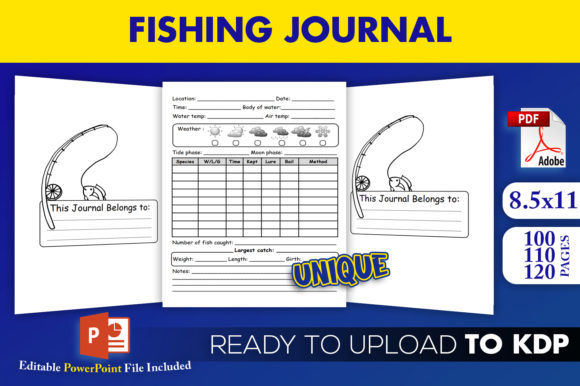
Understanding the technical parameters of this asset is essential for seamless integration into your publishing pipeline. The Fishing Journal Fish Record KDP Interior is formatted to a standard 8.5×11 trim size, which is the industry benchmark for logbooks and journals. This dimension offers ample writing space for users while maintaining cost-effective printing margins. Crucially, the files have been tested on KDP, mitigating the risk of rejection due to bleed errors, margin violations, or resolution issues. This pre-validation step saves hours of troubleshooting and prevents account warnings associated with formatting failures.
The download package supports three distinct production scenarios through its varied page counts:
- 100-Page Version: Ideal for lightweight, portable field journals or budget-friendly entry-level products.
- 110-Page Version: A balanced option suitable for seasonal logs or specific trip records.
- 120-Page Version: Best for comprehensive annual records or premium editions requiring additional reference pages.
Having these variations ready allows publishers to test different price points and spine widths without redesigning the interior. The high-resolution interiors ensure that lines, text, and graphics remain crisp after printing, which is a critical quality control factor for physical books. Blurry interiors are a primary driver of negative reviews in the low-content category; starting with verified high-res assets protects brand reputation.
Leveraging the Editable PowerPoint Source File
The inclusion of an editable PowerPoint (PPTX) source file distinguishes this asset from rigid PDF-only templates. For entrepreneurs and marketers, this editability is where long-term value lies. It allows for customization that aligns with specific sub-niches or branding strategies without requiring Adobe InDesign proficiency. You can modify headers, adjust column widths for specific catch data, add personal branding elements, or translate content for international markets.
In a practical workflow, the PPTX file serves as the master template. Before uploading to KDP, consider how minor adjustments can create entirely new products. For example, changing the terminology from general "Fish Record" to "Bass Fishing Log" or "Fly Fishing Journal" targets different search intents while using the same underlying structure. This approach maximizes the return on investment for a single design asset. Furthermore, the ability to edit ensures longevity; if KDP updates its margin requirements or if user feedback suggests a layout improvement, you can update the master file and regenerate all PDF versions efficiently.
Pre-Publication Quality Assurance
Even though the files are pre-tested, integrating a personal verification step is best practice. Download the provided PDFs and open them in your preferred PDF viewer at 100% zoom to inspect line weights and text clarity. If you make edits in PowerPoint, always export to PDF and run the file through the KDP Previewer tool again. Changes to font sizes or image placement can shift margins, potentially triggering bleed warnings. Treating the provided test status as a baseline rather than a guarantee ensures that your specific modifications maintain compliance.
Strategic Implementation Across Business Models
The utility of the Fishing Journal Fish Record KDP Interior extends beyond simple upload-and-forget publishing. Its application varies depending on whether you are a volume publisher, a niche specialist, or a creator building a personal brand.
For Volume Publishers and Portfolio Builders
Efficiency is paramount when managing hundreds of SKUs. This interior acts as a standardized module. By maintaining a consistent interior structure across a series of outdoor journals, you reduce cognitive load during the creation process and establish a recognizable user experience for repeat customers. The three page-count options allow for A/B testing via organic listings. You might publish the 100-page version at a lower price point to capture volume sales while positioning the 120-page version as a premium alternative. Tracking sales velocity between these variants provides data-driven insights into consumer preferences within the fishing niche.
For Niche Specialists and Brand Builders
If your focus is establishing authority in the angling community, the editable nature of this interior supports deeper customization. Use the PPTX file to insert proprietary tracking metrics, local regulation summaries, or species identification guides relevant to a specific region. This transforms a generic logbook into a specialized tool that solves specific problems for local anglers. Such specificity often leads to higher conversion rates and better organic ranking because the product matches long-tail search queries more precisely than generic competitors.
For Educators and Guide Services
Fishing guides, charter captains, and outdoor educators can utilize this interior as a value-add product or operational tool. Customizing the journal with company logos, safety checklists, or trip-specific waypoints turns it into a branded takeaway for clients. In this context, the journal serves a dual purpose: it enhances the customer experience and acts as physical marketing material. The 8.5×11 size is particularly suitable for this use case, as it accommodates detailed trip logs and educational notes that smaller formats cannot support.
Optimizing Metadata and Listing Strategy
While the interior is a production asset, its features should inform your metadata strategy. When listing a book created with this Fishing Journal Fish Record KDP Interior, explicitly mention the functional attributes derived from the template. Highlight the specific page count, the 8.5×11 dimensions, and the type of recording fields included. Customers searching for fishing logs are looking for utility; they want to know if there is space for weather conditions, bait types, GPS coordinates, or sketch areas.
Avoid generic descriptions. Instead, map the interior’s features to user benefits. For instance, rather than simply stating "110 pages," explain that the 110-page format is optimized for a standard fishing season or a multi-day tournament. This alignment between product reality and listing copy reduces returns and increases satisfaction. Since the interior is high-resolution and tested, you can confidently state that the print quality meets professional standards, addressing a common pain point in buyer reviews for similar products.
Maintaining Consistency and Long-Term Value
Sustainable publishing requires systems that prevent burnout and ensure quality. Integrating this interior into your workflow establishes a baseline for consistency. Keep your master PPTX file organized with clear naming conventions indicating the version, page count, and last modification date. If you develop successful variations, document the changes made so they can be replicated or refined later.
Consider the lifecycle of the product. Fishing trends, regulations, and recording preferences evolve. The editable source file allows you to future-proof your catalog. If a new invasive species becomes a concern in a target market, you can quickly add a reference page. If users request more space for sketches, you can adjust the layout in the next edition. This adaptability makes the Fishing Journal Fish Record KDP Interior a living asset rather than a disposable template.
Ultimately, success in low-content publishing depends on the intersection of efficient production and genuine user value. This interior package facilitates the former so you can focus on the latter. By leveraging the tested PDFs for speed and the PPTX for differentiation, you create a workflow that balances scalability with quality. Whether you are launching your first fishing journal or expanding an established outdoor brand, this resource provides the technical reliability and creative flexibility necessary to compete effectively in the marketplace.