25 Diamond Mazes for KDP Activity Books: A Practical Resource for Publishers
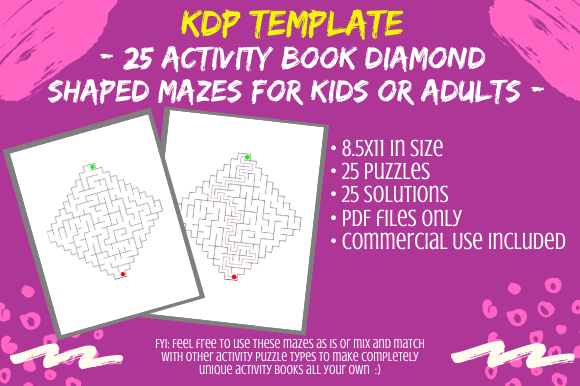
Creating a profitable low-content book on Amazon KDP often comes down to finding the right balance between efficiency and uniqueness. The 25 Diamond Mazes for KDP Activity Books package serves as a foundational asset for publishers looking to diversify their puzzle offerings without spending dozens of hours generating individual graphics. This digital resource provides 25 distinct diamond-shaped maze interiors formatted specifically for the 8.5x11 inch trim size with no bleed, making them immediately compatible with standard KDP printing specifications. Rather than being a finished product, this collection functions as a modular toolkit designed to be edited, expanded, and integrated into larger projects.
The primary value here lies in the flexibility of the format. Because the file is delivered as a single PDF containing both puzzles and solutions, it bridges the gap between ready-to-publish content and customizable templates. For self-publishers who have moved past simple grid mazes and want to introduce geometric variety to their activity books, these diamond layouts offer a visual break that keeps solvers engaged. However, success with this asset requires understanding not just what it is, but how to manipulate it effectively to avoid common platform pitfalls while maximizing creative potential.
Real-World Applications for Puzzle Creators
The most immediate application for this interior is the creation of niche-specific activity books where standard square or circular mazes feel repetitive. Consider a publisher focusing on "Mindfulness for Teens" or "Cognitive Exercises for Seniors." In these contexts, the diamond shape itself acts as a pattern interrupt. When a user flips through a book and encounters a non-standard maze boundary, it resets their attention span. You might use five of these diamond mazes interspersed throughout a 100-page journal to serve as mental palate cleansers between writing prompts or coloring pages. This mixed-media approach increases the perceived value of the book without requiring you to design complex puzzles from scratch.
Educators and homeschool resource creators also find significant utility in this type of geometric puzzle. Fine motor skill development and spatial reasoning are critical for early learners, and the angular nature of diamond mazes presents a different cognitive challenge than traditional rectangular paths. A teacher creating supplemental worksheets could extract specific pages from this collection to build custom handouts. Because the file is editable via online PDF converters, an educator could easily add a vocabulary list at the bottom of the page or incorporate a thematic border related to a current lesson plan, transforming a generic maze into a targeted learning tool.
For established KDP authors managing a large catalog, this resource solves the problem of content fatigue. If you have published several maze books using the same generator software, your audience may begin to recognize the patterns. Integrating these 25 unique diamond layouts introduces fresh visual variety into your backlist or upcoming titles. You can take ten of these mazes and combine them with word searches, sudoku, or cryptograms to create a "Variety Puzzle Book" that appeals to travelers or commuters looking for diverse entertainment in a single volume. The ability to mix and match allows you to test new niches with minimal upfront investment.
Customization Strategies to Ensure Originality
It is vital to address the issue of duplicate content directly. Amazon’s algorithms are increasingly sophisticated at identifying identical interiors across multiple accounts. Using the 25 Diamond Mazes for KDP Activity Books exactly as provided carries a risk of being flagged or having your book blocked. Therefore, treating this PDF as raw material rather than a final manuscript is essential. Before uploading anything to KDP, you should implement substantial modifications to make the content uniquely yours.
- Visual Layering: Add clip art, decorative borders, or background textures to the maze pages. Even subtle changes like adding a themed icon in the corner of each page can differentiate your interior from others using the same source file.
- Text Integration: Change the page titles, add instructions, include inspirational quotes, or insert fun facts related to the maze difficulty. Textual additions increase the uniqueness score of your document significantly.
- Structural Reorganization: Do not publish the 25 mazes in the exact order they appear in the source file. Shuffle them, remove some, or intersperse them with other content types. Creating a new flow disrupts the digital fingerprint of the original file.
- Hybrid Content Creation: Combine these diamond mazes with coloring elements. You could turn the negative space around the diamond into a zentangle pattern or a coloring scene, effectively creating a dual-purpose activity page that no longer resembles the base template.
These modifications do more than just satisfy Amazon's terms; they enhance the customer experience. Buyers are looking for cohesive, thoughtfully designed books, not collections of stock assets. By investing time in customization, you transform a commodity into a branded product.
Technical Considerations and Workflow Best Practices
Working with pre-formatted PDF interiors requires a disciplined workflow to prevent errors during the publishing process. Since this resource includes 50 pages total (25 puzzles and 25 solutions), you must manage pagination carefully when integrating it into a larger manuscript. The no-bleed specification means all content is safely contained within the margins, which simplifies formatting but also limits design options if you later decide to switch to a full-bleed layout. Always verify your trim size settings in KDP before uploading, as resizing a no-bleed PDF to fit a different dimension can distort the maze geometry and render the puzzle unsolvable.
File management is another practical consideration. The recommendation to create a duplicate working copy cannot be overstated. Digital assets are easily overwritten or corrupted during the editing process, especially when using free online PDF converters. Maintain a pristine master file stored in a separate folder or cloud backup. Work exclusively on copies labeled with version numbers or project names. This practice ensures that if a conversion fails or an edit goes wrong, you can always revert to the original source without repurchasing or redownloading.
When editing, pay close attention to the solution pages. It is a common mistake to modify the puzzle pages—adding graphics, changing titles, or adjusting margins—while forgetting to update the corresponding solution keys. Nothing generates negative reviews faster than mismatched answers. After every round of edits, print a physical proof or conduct a thorough digital review to ensure that Solution Page 1 still corresponds accurately to Puzzle Page 1, especially if you have reordered or deleted pages. Consistency in navigation and answer accuracy is what separates professional activity books from amateur productions.
Evaluating Fit for Your Publishing Goals
While this diamond maze collection offers significant advantages, it is important to recognize its limitations relative to your specific goals. If your intention is to publish a standalone "Diamond Maze Book" consisting solely of these 25 puzzles, the page count may be too low to meet reader expectations or KDP’s minimum thresholds for certain distribution options. This asset shines brightest as a component of a larger strategy rather than a complete product. Publishers seeking high-volume, automated publishing may find the required customization steps too labor-intensive, whereas those building a quality-focused brand will appreciate the head start on design.
Additionally, consider your target demographic's preferences. Diamond mazes have a distinct aesthetic that may not align with every niche. They tend to perform well in abstract puzzle books, mindfulness journals, and adult activity collections, but might feel out of place in a character-driven children's maze book unless heavily themed. Testing the market by incorporating a few of these mazes into an existing variety book can provide valuable data on audience reception before committing to a dedicated title.
Ultimately, the 25 Diamond Mazes for KDP Activity Books represents a strategic shortcut for creators who understand that value comes from curation and adaptation. It removes the technical barrier of maze generation while preserving the creative opportunity of book design. By approaching this resource as a flexible foundation rather than a finished solution, publishers can efficiently expand their catalogs, experiment with new formats, and deliver engaging content that stands out in a crowded marketplace. The key to long-term success lies in respecting both the platform's guidelines and the end-user's desire for original, polished experiences.