Optimizing Your Blood Glucose Logbook for KDP: Design, Editing, and Profitability
Strategic Interior Architecture for Health Tracking
Creating a successful low-content book requires more than just blank lines; it demands a user-centric architecture that solves a specific problem. For creators developing a Blood Glucose Logbook for KDP, the interior layout serves as the primary value proposition. A well-structured logbook transforms from a simple notebook into an essential health management tool. The specific template discussed here utilizes a comprehensive 123-page structure designed to capture holistic health data rather than isolated blood sugar readings. This approach aligns with modern diabetes management trends that recognize the interplay between sleep, stress, hydration, and glucose levels.
The interior begins with foundational front matter. A dedicated title page establishes professionalism, while a separate copyright page allows publishers to insert their specific brand name. This separation is crucial for building a recognizable series or imprint within the competitive health niche. Following the front matter, the core utility lies in the 120 daily tracking pages. Unlike generic journals, this layout provides ten distinct entry slots per day. This high-frequency capacity accommodates users who test multiple times daily, including pre-meal, post-meal, bedtime, and nocturnal checks. By providing ample space for ten entries, the logbook prevents users from running out of room during intensive monitoring periods, thereby increasing the perceived longevity and value of the physical product.
Holistic Data Points Beyond Glucose
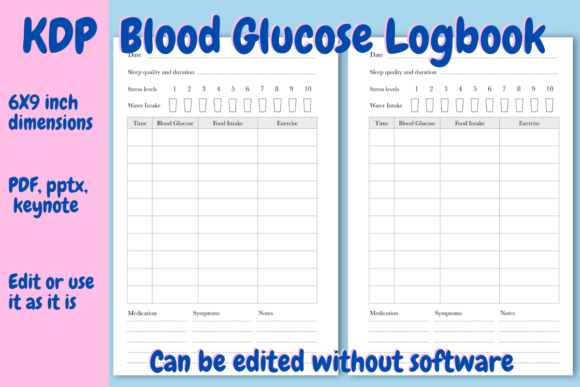
Differentiation in the KDP marketplace often hinges on the granularity of data collection. Standard logbooks frequently fail to account for variables that influence glycemic control. This specific template integrates critical contextual metrics directly into the daily spread. Each page includes dedicated fields for:
- Sleep Quality: Poor sleep increases cortisol and insulin resistance, making this a vital correlation metric.
- Stress Levels: Emotional and physical stress can cause unexplained spikes independent of food intake.
- Water Consumption: Hydration status affects blood volume and glucose concentration.
- Medications Taken: Tracking dosage timing alongside glucose readings helps verify therapeutic efficacy.
- Symptoms and Notes: Qualitative data that captures how the patient feels, which numbers alone cannot convey.
Incorporating these elements creates a "Blood Glucose Logbook for KDP" that serves as a functional medical diary. When users present this logbook to endocrinologists or dietitians, the additional context enables healthcare providers to make more informed treatment adjustments. This practical utility drives positive reviews and repeat customers, as the book actively participates in the user's health journey rather than passively recording it.
Accessible Editing Workflows Without Proprietary Software
A significant barrier to entry for many KDP publishers is the reliance on expensive design software like Adobe InDesign. However, the democratization of publishing tools has made professional formatting accessible through free alternatives. This particular logbook template is engineered for maximum compatibility, available in PDF, Keynote, and PowerPoint (PPTX) formats. Crucially, the PPTX file has been pre-formatted specifically for Google Slides integration. This strategic formatting decision ensures that creators without access to Microsoft Office or Apple Keynote can still fully customize the product.
The workflow for editing via Google Slides is streamlined for efficiency. Users simply require a free Gmail account to access the platform. The process involves uploading the PPTX source file to Google Drive and opening it natively within Google Slides. Because the master slides and text boxes are pre-configured, the layout remains intact during the conversion. Publishers can modify fonts, adjust table borders, update the copyright information, or tweak column widths directly in the browser. Once edits are complete, the file is exported as a print-ready PDF. This cloud-native workflow eliminates version control issues and allows for collaboration, enabling teams to review or edit the logbook remotely without transferring large files.
Customization Through Duplication and Deletion
Flexibility is paramount when adapting a template for different sub-niches. While the standard configuration offers 120 daily pages, market research may indicate a need for variation. Some users prefer quarterly logs (90 days), while others seek annual trackers. The template supports dynamic resizing through simple right-click functionality. To increase the page count, publishers can select any daily page, right-click, and choose "Duplicate." This preserves all formatting, margins, and bleed settings perfectly. Conversely, if a thinner book is desired to reduce costs or target a travel-friendly demographic, extra pages can be deleted instantly.
This modularity extends to content enhancement. Creators are encouraged to make the document unique by inserting illustrations, motivational quotes, or educational tip sheets between daily logs. Adding value-added content not only distinguishes the product from competitors using identical base templates but also enhances the user experience. For example, inserting a weekly reflection page every seven days transforms a daily tracker into a comprehensive wellness journal. These modifications are easily executed within the slide-based environment, treating each page as an independent canvas while maintaining global consistency.
Economic Viability and Print Cost Management
Profitability in low-content publishing is a function of pricing strategy versus fixed printing costs. Understanding the unit economics of a Blood Glucose Logbook for KDP is essential for sustainable business planning. This specific 123-page, 6x9 inch configuration carries a tested printing cost of approximately $2.33 USD. This price point is derived from Amazon KDP’s standard black and white ink options on white paper with a matte or glossy cover. At this production cost, publishers have significant flexibility in setting retail prices to achieve healthy royalty margins.
The relationship between page count and printing cost is linear but stepped. By utilizing the deletion feature mentioned previously, publishers can experiment with lower page counts to potentially drop below certain pricing thresholds. For instance, reducing the book to 100 pages might lower the printing cost sufficiently to allow for a more aggressive promotional price while maintaining the same royalty per unit. Conversely, adding educational content or expanding to 150 pages increases the perceived value, justifying a higher retail price that absorbs the increased printing cost. The ability to test these variations using the editable source files allows publishers to A/B test different configurations without reinvesting in design.
Technical Compliance and Preview Testing
One of the most common reasons for KDP rejection or poor customer feedback is technical formatting errors. Margins that are too narrow, text in the gutter, or incorrect bleed settings can render a logbook unusable. This template has been rigorously tested on the KDP previewer to ensure compliance with current publishing standards. The 6x9 inch trim size is an industry standard for health journals, offering a balance between portability and writing space. The tables are sized to accommodate handwriting while remaining legible when printed at scale.
Publishers should always perform their own verification after making edits. Even minor adjustments in Google Slides can shift elements. Before final upload, download the edited PDF and run it through the KDP Previewer tool again. Check specifically for:
- Gutter Margins: Ensure the inner margin is sufficient so that writing near the spine is not obscured by the binding.
- Table Alignment: Verify that grid lines remain crisp and that rows are evenly spaced across all duplicated pages.
- Bleed Safety: If adding illustrations or colored backgrounds, confirm they extend beyond the trim line to prevent white borders after cutting.
- Text Legibility: Zoom to 100% to ensure font sizes remain readable in print format, as screen resolution often deceives the eye.
Adhering to these technical checkpoints ensures that the final product meets professional standards. A technically flawless interior reduces return rates and negative reviews related to manufacturing defects, protecting the long-term reputation of the publisher’s brand.
Market Positioning and User Experience Considerations
Success with a Blood Glucose Logbook for KDP ultimately depends on how well it serves the end-user's daily reality. The design choices embedded in this template reflect a deep understanding of diabetic care routines. The inclusion of a notes section on every page, for example, addresses the frustration users feel when they experience an anomalous reading and have nowhere to record the potential cause. Similarly, tracking exercise alongside food intake acknowledges the bidirectional impact of lifestyle factors on blood sugar. These thoughtful design elements signal to the buyer that the creator understands their needs.
Furthermore, the availability of multiple file formats (PDF, Keynote, PPTX) future-proofs the asset. Technology ecosystems change; a publisher who relies solely on one proprietary format risks obsolescence. By maintaining source files in open or widely supported formats, the logbook remains editable for years. This sustainability aspect is particularly relevant for educators and healthcare organizations that may wish to adapt the logbook for patient education programs or clinical trials. The ease of customization allows these institutions to add logos, study-specific fields, or localized language translations without hiring a graphic designer.
Ultimately, the convergence of accessible editing tools, holistic health tracking, and sound economic modeling makes this logbook template a robust foundation for KDP success. Whether used as-is for rapid deployment or heavily customized to create a unique brand asset, the focus remains on delivering tangible value to individuals managing their health. By prioritizing user experience and technical precision, publishers can build a sustainable portfolio in the health and wellness niche that stands the test of both market trends and platform algorithms.