Evaluating the KDP Interior Teacher Students Planner for Self-Publishing Success
Creating a successful low-content or medium-content book on Amazon requires more than just a catchy cover; the interior quality determines whether a customer leaves a positive review or returns the product. For publishers targeting the education niche, the KDP Interior Teacher Students Planner represents a specific category of pre-formatted assets designed to bridge the gap between generic notebooks and fully customized educational tools. This resource is distinct because it offers editable source files alongside print-ready PDFs, allowing creators to modify layouts rather than simply uploading static templates. Understanding the practical applications, limitations, and comparative advantages of this planner system is essential for authors deciding whether to build from scratch, hire a designer, or utilize pre-made interiors.
Distinguishing Features and Technical Specifications
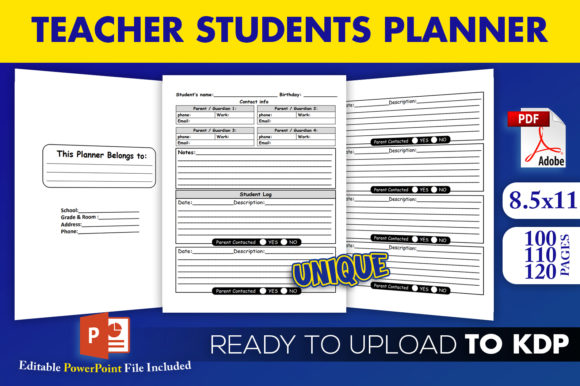
When evaluating digital assets for Kindle Direct Publishing, technical compliance is the baseline requirement. The KDP Interior Teacher Students Planner is structured around the standard 8.5x11 inch trim size, which remains the industry standard for academic planners due to its compatibility with standard paper sizes and classroom storage solutions. A critical differentiator for this specific package is the inclusion of an editable PowerPoint (PPTX) source file. Unlike many marketplace listings that provide only flattened PDFs, the PPTX format allows users to adjust fonts, reposition headers, add school-specific branding, or modify date fields without needing advanced graphic design software like Adobe InDesign.
The package typically includes three distinct PDF variations with page counts of 100, 110, and 120 pages. This variation addresses a common pain point in self-publishing: spine width calculation. Authors often struggle to match their cover design to a fixed interior page count. By providing multiple lengths, this planner system offers flexibility for testing different price points and perceived values. Furthermore, these files are marketed as having been tested on KDP, implying that margins, bleed settings, and safe zones have already been validated against Amazon’s automated review bots. This pre-validation can save hours of troubleshooting rejected manuscripts, particularly for new publishers unfamiliar with gutter margin requirements for thicker books.
High-Resolution Standards and Print Quality
Visual clarity is non-negotiable in educational materials. Teachers and students rely on legible lines, clear calendars, and sharp instructional graphics. The high-resolution specification of these interiors ensures that text and grid lines remain crisp when printed via Amazon’s standard black-and-white or color offset printing processes. Low-resolution templates often result in pixelated lines or gray-scale banding, which leads to negative reviews citing "poor print quality" even when the issue stems from the source file rather than the printer. Verifying that the KDP Interior Teacher Students Planner maintains vector-quality sharpness at 100% zoom is a necessary step before finalizing any purchase.
Comparing Pre-Made Interiors Against Custom Design Alternatives
Publishers generally face three paths when creating teacher planners: designing from scratch, hiring a freelancer, or purchasing pre-made interiors like this one. Each approach carries distinct tradeoffs regarding cost, time, and exclusivity.
- Custom Design: Creating a planner from zero offers total uniqueness and copyright ownership. However, it requires proficiency in layout design and a significant time investment. For a single title, the return on investment may not justify 40+ hours of design work unless the author plans to create a long-term series.
- Freelance Designers: Hiring a professional ensures high quality and custom features but introduces higher upfront costs ranging from $100 to $500+. Communication lag and revision rounds can also delay launch schedules. This route is best for established publishers with proven sales volume.
- Pre-Made Editable Interiors: The KDP Interior Teacher Students Planner occupies the middle ground. It reduces production time to mere hours while retaining enough customization potential to avoid looking identical to competitors. The tradeoff is non-exclusivity; other sellers may use the same base template. Success with this option depends heavily on how effectively the user modifies the editable elements to create a unique value proposition.
For authors aged 20–50 who are balancing publishing with full-time careers or teaching jobs, the editable pre-made option often provides the most realistic balance of speed and quality. It eliminates the technical learning curve of formatting while avoiding the premium expense of custom design services.
Evaluating Content Relevance and Niche Fit
Not all teacher planners serve the same audience. A generic planner may fail to resonate with specialized educators such as special education teachers, homeschool parents, or university professors. When assessing the KDP Interior Teacher Students Planner, examine the specific layout structures included. Does it feature grade-tracking grids suitable for K-12 standards? Are there sections for IEP goals, parent communication logs, or curriculum mapping? If the interior pages are too generalized, they may compete directly with thousands of other basic planners. Conversely, if the layouts include specialized pedagogical frameworks, they can serve as a strong foundation for a niche product. The ability to edit the PPTX file becomes crucial here, as it allows publishers to swap out generic headers for niche-specific terminology without redesigning the entire page structure.
Strategic Decision Factors and Best-Fit Scenarios
Determining whether this specific planner asset aligns with your publishing goals requires honest assessment of your current capabilities and market strategy. The KDP Interior Teacher Students Planner is likely the right choice if you prioritize speed-to-market and lack advanced typography skills. It is particularly valuable for publishers building a portfolio of seasonal products who need reliable, compliant templates that can be quickly adapted for different academic years or regional school systems. The inclusion of tested PDFs also makes it suitable for those who have previously faced manuscript rejection issues and want to minimize technical friction.
However, this option may not be ideal for authors seeking to build a defensible brand moat based entirely on proprietary content. If your business model relies on being the sole provider of a specific planning methodology, a pre-made template—even an editable one—may limit your intellectual property protection. Additionally, if you target international markets with different paper sizes (such as A4), an 8.5x11 inch template would require significant resizing that could distort layouts, making a native A4 template a superior alternative.
Maximizing Value Through Customization
To differentiate a product based on the KDP Interior Teacher Students Planner, publishers should leverage the editable source file strategically. Simple modifications can significantly alter the perceived value and reduce direct competition. Consider adding introductory pages that explain the planner’s methodology, inserting motivational quotes relevant to specific grade levels, or creating custom divider tabs that match your cover aesthetic. Changing color schemes for section headers or adjusting font pairings to improve accessibility for neurodivergent users are subtle changes that transform a stock template into a specialized tool. These enhancements not only improve user experience but also signal to Amazon’s algorithm and potential buyers that the book offers unique content beyond a basic commodity.
Understanding Limitations and Risk Management
While pre-tested interiors reduce technical risks, they introduce market saturation risks. Because these assets are available to multiple buyers, there is always a possibility of similar products appearing in search results. Publishers must mitigate this through superior keyword research, compelling cover design, and enhanced A+ Content that highlights the specific benefits of their version. Another consideration is licensing terms; always verify whether the purchased planner allows for unlimited commercial use or imposes caps on the number of published titles. Some licenses restrict usage to personal projects or require attribution, which could complicate commercial publishing strategies.
Furthermore, reliance on PowerPoint for editing has inherent limitations compared to professional layout software. PPTX files may not support advanced typographic features like optical kerning or complex master page automation. Users accustomed to InDesign might find the workflow restrictive, particularly when managing consistent styling across 120 pages. Testing the editing functionality before committing to large-scale production is advisable to ensure the software meets your efficiency standards.
Final Assessment for Informed Purchasing
The KDP Interior Teacher Students Planner serves as a practical infrastructure component for self-publishers operating in the education sector. Its combination of tested PDFs, editable source files, and variable page counts addresses both technical compliance and creative flexibility needs. For adults exploring entry into educational publishing or seeking to streamline existing workflows, it offers a viable alternative to expensive custom design or time-intensive DIY formatting. Success ultimately depends not on the template itself, but on how thoughtfully the publisher adapts it to serve specific educator needs. By viewing this planner as a foundational canvas rather than a finished product, authors can create resources that genuinely support teachers and students while building sustainable publishing businesses.