Weekly Meal Planner - KDP Interior: A Practical Resource for Publishers and Personal Organization
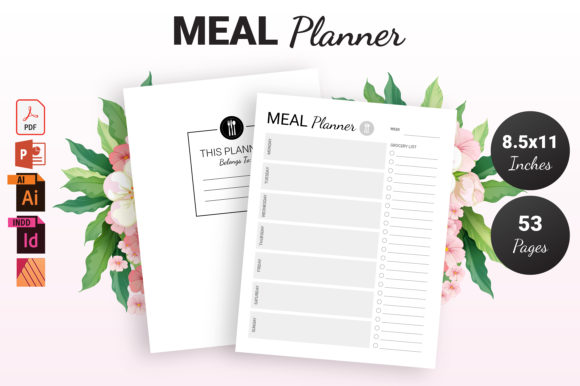
Creating a successful low-content or medium-content book on Amazon KDP often comes down to utility and design quality. The Weekly Meal Planner - KDP Interior is designed specifically to bridge the gap between a functional daily tool and a professional publishing asset. This isn't just a collection of blank tables; it is a comprehensive 53-page layout system formatted at 8.5 x 11 inches with no bleed, making it immediately compatible with standard paperback printing requirements. For entrepreneurs, freelancers, and content creators, this resource serves two distinct but equally valuable purposes: it acts as a ready-to-publish product for your KDP portfolio, and it provides a customizable foundation for personal or client-based nutrition organization.
Accelerating the Publishing Workflow for KDP Creators
For self-publishers and digital marketers, time is the most significant bottleneck. Designing a meal planner from scratch involves calculating margins, setting up grid systems, ensuring text safety zones, and testing print proofs. This Weekly Meal Planner - KDP Interior eliminates that technical friction. Because the files are pre-formatted to industry standards, you can move from download to upload in minutes rather than days. The inclusion of source files in PowerPoint, Illustrator, InDesign, Affinity Publisher, and PDF formats means you are not locked into a single software ecosystem.
Consider a scenario where you manage multiple niche pen names. You might need a "Keto Meal Planner" for one brand and a "Budget Family Grocery Tracker" for another. With editable source files like INDD or AFPUB, you can open the master template, swap out the fonts, adjust the header graphics, and change the introductory text to match the specific niche. This flexibility allows you to scale your publishing business efficiently without hiring a designer for every new variation. The high-quality print-ready PDF ensures that even if you choose not to customize the interior, the final physical product will look crisp and professional when it arrives at the customer's doorstep.
Real-World Applications for Health Coaches and Nutritionists
Beyond publishing, this interior template is a practical operational tool for wellness professionals. Health coaches, dietitians, and personal trainers often struggle with providing clients with tangible takeaways that don't look like generic internet printouts. By utilizing the editable versions of this Weekly Meal Planner, professionals can create branded client workbooks. A nutritionist could add their logo to the footer, include a personalized hydration tracking section, or modify the meal slots to reflect specific macro-nutrient goals relevant to their coaching program.
This application extends to corporate wellness programs and educators as well. If you are running a workshop on healthy eating habits for employees or students, having a professionally laid-out planner adds credibility to your material. Instead of asking participants to draw their own grids or use disparate apps, you provide a unified, structured resource. The 8.5 x 11 dimension offers ample writing space, which is crucial for users who prefer handwriting their plans over digital entry. The 53-page count strikes a balance between being substantial enough to feel like a real book while remaining lightweight enough to carry in a gym bag or keep on a kitchen counter.
Personal Organization and Household Management
For everyday users, bloggers, and busy parents, the value lies in the immediate usability of the PDF format. Meal planning is often cited as the number one strategy for reducing household food waste and grocery bills, yet many people abandon the habit because their tools are too complicated or aesthetically unpleasing. This interior provides a clean, distraction-free structure that encourages consistency. The no-bleed specification means there are no design elements getting cut off at the edges, resulting in a neat, organized appearance that reduces cognitive load during stressful weekly planning sessions.
Hobbyists and home cooks who document their culinary experiments also benefit from this structured approach. Food bloggers, for instance, can use the planner to map out recipe testing schedules alongside family meals. By printing the PDF at home or through a local print shop, they can maintain a physical archive of what worked and what didn't, separate from their digital content creation workflow. This analog-digital hybrid approach helps prevent burnout by creating a dedicated physical space for planning that isn't tied to screen time.
Evaluating File Formats for Your Specific Needs
Before downloading or purchasing this Weekly Meal Planner - KDP Interior, it is essential to understand which file format aligns with your current capabilities and goals. While the print-ready PDF is universal, the source files require specific software proficiency. If you intend to make significant structural changes, such as adding a monthly calendar view or altering the column widths, Adobe InDesign (INDD) or Affinity Publisher (AFPUB) are the superior choices due to their advanced typographic and layout controls. These programs handle master pages and paragraph styles more robustly than other options.
However, if your customization needs are lighter—perhaps changing colors, adding a logo, or updating text labels—PowerPoint (PPTX) or Illustrator (AI) may be more accessible. PowerPoint is surprisingly capable for basic layout edits and is familiar to most business users, lowering the learning curve significantly. Illustrator is ideal if you plan to integrate complex vector graphics or want to redesign the cover art to match the interior aesthetic. Understanding these distinctions prevents frustration and ensures you select the right tool for your level of expertise.
Strategic Considerations Before Implementation
While this template solves design and formatting challenges, success depends on how you position the final product. If you are using this for KDP, remember that the interior is only half the equation. You must still invest time in keyword research, cover design, and writing a compelling book description. The market for meal planners is competitive, so consider how you can differentiate your version. Perhaps you focus on a specific demographic like college students, postpartum mothers, or seniors managing diabetes. The template provides the skeleton, but your unique value proposition provides the muscle.
For non-publishers using this for personal or professional organization, consider the longevity of the planner. Fifty-three pages typically cover about six months of weekly planning if used continuously, or a full year if used seasonally. Think about whether you need additional sections for inventory management, recipe indexing, or budget tracking. Since you have access to editable files, you can insert these extra pages before printing or publishing. This foresight transforms a generic template into a bespoke solution that actually fits your lifestyle or business model.
Maximizing Value Through Customization
The true power of this Weekly Meal Planner - KDP Interior lies in its adaptability. It is not merely a static product but a dynamic framework. Entrepreneurs can bundle it with other digital products as a lead magnet to build an email list. Educators can use it as a teaching aid for life skills classes. Freelancers can offer "planner setup" services to clients who want customized organization systems but lack the design skills to create them. In each case, the 8.5 x 11 no-bleed specification remains a constant advantage, ensuring compatibility across various printing methods and platforms.
Ultimately, whether you are building a passive income stream on Amazon or trying to get your family to eat more vegetables on Tuesday nights, the goal is to reduce friction. This resource removes the technical barriers to entry, allowing you to focus on the content and the outcome. By leveraging high-quality, pre-formatted files, you reclaim hours of productive time that can be better spent on marketing, cooking, coaching, or simply enjoying the results of your organized week. The investment in a versatile template pays dividends not just in money saved on design fees, but in the sustained momentum of your projects and personal habits.